Eisenhower by Stephen E. Ambrose
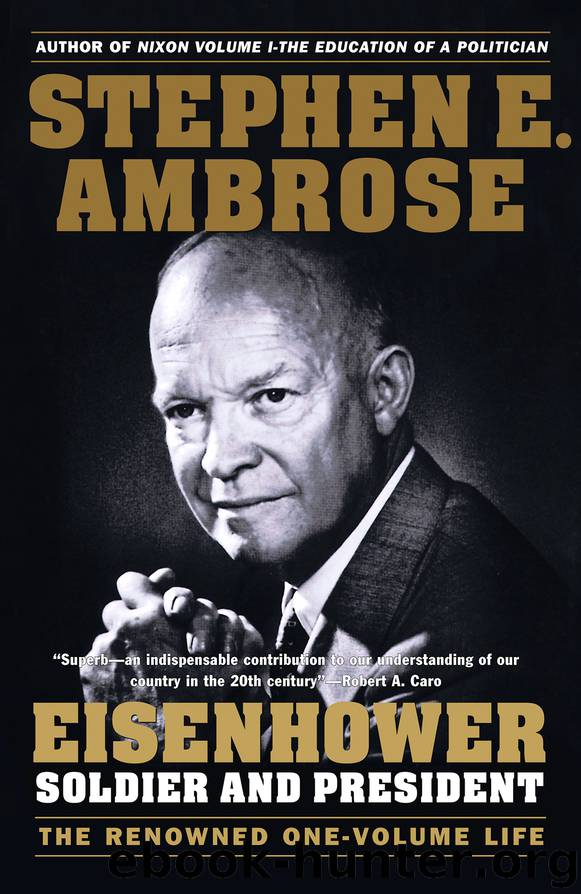
Author:Stephen E. Ambrose
Language: eng
Format: epub
Publisher: Simon & Schuster
CHAPTER THIRTEEN
Peace in Korea—Coup in Iran—Atoms for Peace
WHEN EISENHOWER returned to Washington, Korea was at the center of his attention. The Communists said they were ready to begin again the armistice talks with the U.N. team at Panmunjom. Dulles wanted to reject the offer. At an NSC April 8 meeting, he told Eisenhower that “it was now quite possible to secure a much more satisfactory settlement in Korea than a mere armistice at the thirty-eighth parallel, which would leave a divided Korea.” Dulles believed that if a military armistice was not followed by a “political settlement,” meaning the unification of Korea, the United States would have to break the armistice.
Eisenhower would have none of that. He told Dulles “it will be impossible to call off the armistice and to go to war again in Korea. The American people will never stand for such a move.”1
In Panmunjom, meanwhile, both sides were negotiating seriously, taking new positions on the complex problem of Chinese and North Korean POWs who did not want to return home. The Indian government was proposing a compromise solution that appealed to both sides. But not to Dulles. He flew to Karachi for talks with Prime Minister Jawaharlal Nehru. This trip has since become famous, because during the talks Dulles supposedly told Nehru that the United States might feel compelled “to use atomic weapons if a truce could not be arranged.” In fact, no such direct warning was made, nor was it necessary. The full text of Dulles’ report to Eisenhower on his conversation with Nehru read: “Nehru brought up Korean armistice, referring particularly to my statement of preceding day, that if no (repeat no) armistice occurred hostilities might become more intense. He said if this happened it difficult to know what end might be. He urged withdrawal our armistice proposals as inconsistent with the Indian resolutions. He made no (repeat no) alternate proposal. He brought up again my reference to intensified operations, but I made no (repeat no) comment and allowed the topic to drop.”2
Dulles did not need to make any direct threats, much less depend on Nehru to pass them along to the Chinese. The Communists already knew that Eisenhower had a nuclear option; they knew that his patience was limited; they knew that he was under pressure to widen the war; they knew that the Americans had atomic warheads in Okinawa. On June 4, the Chinese presented a POW proposal that was in substantial accord with the last U.N. offer. Peace was in sight.
Rhee was furious. He had already told Eisenhower that a simple military armistice would mean “a death sentence for Korea without protest.” He proposed, instead, a simultaneous withdrawal of both the Chinese and U.N. forces in Korea, a mutual-defense pact between South Korea and the United States, and an increase in military aid. If this program was unacceptable, he begged Eisenhower to allow the Koreans to continue the fighting, for this “is the universal preference of the Korean people to any divisive armistice of peace.
Download
This site does not store any files on its server. We only index and link to content provided by other sites. Please contact the content providers to delete copyright contents if any and email us, we'll remove relevant links or contents immediately.
| Africa | Americas |
| Arctic & Antarctica | Asia |
| Australia & Oceania | Europe |
| Middle East | Russia |
| United States | World |
| Ancient Civilizations | Military |
| Historical Study & Educational Resources |
The Radium Girls by Kate Moore(12036)
100 Deadly Skills by Clint Emerson(4932)
Rise and Kill First by Ronen Bergman(4797)
The Templars by Dan Jones(4695)
The Doomsday Machine by Daniel Ellsberg(4493)
The Rape of Nanking by Iris Chang(4224)
Killing England by Bill O'Reilly(4008)
Stalin by Stephen Kotkin(3973)
Hitler in Los Angeles by Steven J. Ross(3949)
12 Strong by Doug Stanton(3555)
Hitler's Monsters by Eric Kurlander(3352)
Blood and Sand by Alex Von Tunzelmann(3207)
The Code Book by Simon Singh(3197)
Darkest Hour by Anthony McCarten(3137)
The Art of War Visualized by Jessica Hagy(3014)
Hitler's Flying Saucers: A Guide to German Flying Discs of the Second World War by Stevens Henry(2759)
Babylon's Ark by Lawrence Anthony(2686)
The Second World Wars by Victor Davis Hanson(2529)
Tobruk by Peter Fitzsimons(2521)
